
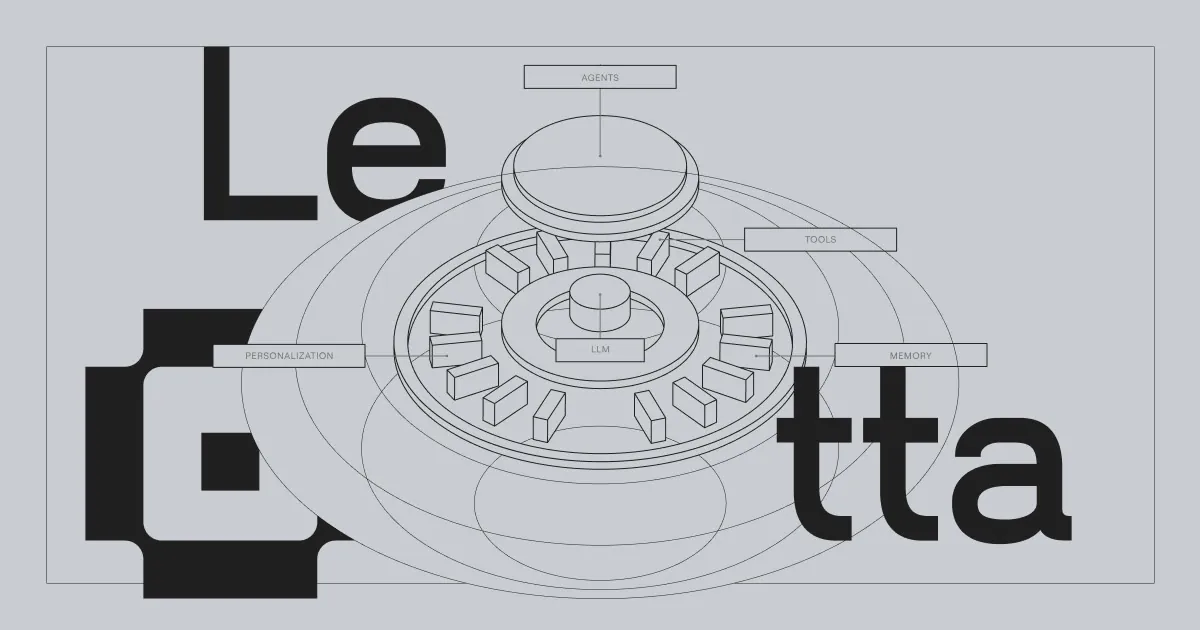
Letta
有状态智能体的平台。使用智能体开发环境在可视化环境中,或使用 Python 和 Node.js SDK 构建具有长期记忆、高级推理和自定义工具的 AI 智能体。
Letta: Building AI Agents That Actually Remember and Learn
Imagine having an AI assistant that doesn't just process your requests in isolation, but actually learns from every interaction, remembers your preferences, and improves over time. That's the promise of Letta, a revolutionary platform that's redefining how we think about AI agents.
The Problem with Today's AI
Most AI tools operate in a stateless paradigm—each conversation exists in a vacuum. You chat with Claude, and then you start fresh the next day. You use ChatGPT for coding, but it forgets your project structure and coding style between sessions. It's like hiring a new contractor every single time you need help.
This fundamental limitation means that despite impressive advances in large language models, we're missing a crucial piece of the puzzle: memory. True intelligence isn't just about processing information in the moment—it's about building on past experiences, forming connections, and continuously improving.
Enter Letta: The Memory-First Agent Platform
Letta takes a completely different approach. Instead of stateless sessions, Letta enables you to build stateful agents—AI systems that maintain persistent memory and actually learn during deployment, not just during training.
Founded by AI researchers from UC Berkeley's Sky Computing Lab and the creators of MemGPT, Letta is built on a simple but powerful philosophy: every AI interaction should build on the last. Memory will become more valuable than the models themselves—state that persists across providers, improvements that compound over time, agents that evolve through use.
Key Features That Set Letta Apart
1. Persistent Stateful Agents
Unlike traditional AI tools where each session is independent, Letta agents persist across sessions. Your agent remembers your codebase, your preferences, and your past interactions. You can start a new conversation (or "thread") with /clear or /new, but your agent's memory remains intact.
Think of it this way: with session-based tools, every conversation is like meeting a new contractor. With Letta's agent-based approach, it's like having a coworker or mentee who actually learns and remembers.
2. Memory-First Architecture
Letta implements a sophisticated hierarchical memory system that includes memory blocks, context repositories with git-based versioning, and the ability to transparently view and modify your agent's memory and context. You can even port memory and conversation histories between models, even from different providers.
3. Model Agnostic Design
Letta doesn't lock you into a single model provider. You can use Claude, GPT, Gemini, or any model you want. Switch between them seamlessly while keeping your agent's memory intact. This freedom means you're not beholden to any single provider and can always use the best tool for the job.
4. Open Source Foundation
Unlike proprietary solutions like Claude Code, Letta is fully open source. This means you can inspect the code, contribute to the project, and deploy it on your own infrastructure. The transparency builds trust and allows for community-driven innovation.
5. Developer-Friendly Tooling
Letta provides multiple ways to build and interact with agents:
- Letta Code: A memory-first coding harness that lives in your terminal
- Agent Development Environment (ADE): A visual environment for building agents
- Python and TypeScript SDKs: For building agents into your applications
- CLI tools: For power users who prefer the command line
6. Sleep-Time Compute
This is perhaps the most innovative feature. Sleep-time compute is a new way to scale AI capabilities by letting models "think" during downtime. Instead of sitting idle between tasks, AI agents can use their "sleep" time to process information and form new connections by rewriting their memory state.
7. Skills and Subagents
You can create reusable skills that your agent can learn, and delegate tasks to specialized subagents. This modular approach allows for sophisticated agent architectures that can handle complex workflows.
Letta Code: The Memory-First Coding Agent
Letta Code, the flagship product, is a memory-first coding agent that lives in your terminal and can learn from experience. It's not just another coding assistant—it's a deeply personalized stateful agent that can take actions on your local computer.
Installation and Getting Started
Getting started is incredibly simple. With Node.js 18+ installed, just run:
npm install -g @letta-ai/letta-code
cd your-project
letta
Within 30 seconds, you'll be chatting with your own personalized coding agent.
What Can Letta Code Do?
- Work in your local computer: Write code, edit and organize files, run programs
- Remember all prior interactions: Your agent persists across sessions
- Self-improve and evolve over time: Directly edit memory blocks or ask the agent to modify itself
- Remote control: Use
letta serverto control agents running on external devices from your phone
Real-World Applications and Use Cases
1. Personal Development Assistant
Build an agent that learns your coding style, understands your project architecture, and provides increasingly relevant suggestions over time. It remembers your preferences and becomes more useful the longer you use it.
2. Enterprise Knowledge Management
Organizations can deploy agents that learn from institutional knowledge, document repositories, and past decisions. These agents become living encyclopedias that grow more valuable with each interaction.
3. Educational Tools
Create personalized tutoring agents that remember student progress, adapt to learning styles, and provide tailored explanations. The agent becomes more effective as it learns how each student learns best.
4. Research Assistants
Researchers can build agents that remember literature reviews, track experimental results, and synthesize information across sessions. The agent becomes a research companion that accumulates expertise over time.
5. Customer Support
Customer service agents can remember each customer's history, preferences, and past issues. Instead of explaining the problem every time, customers get increasingly personalized and efficient support.
Performance and Benchmarks
Letta isn't just theoretical—it delivers real results. Letta Code ranks as the #1 model-agnostic open source agent on Terminal-Bench, achieving a 42.5% overall score and ranking 4th overall, 2nd among agents using Claude 4 Sonnet.
The team has also developed comprehensive evaluation frameworks including Context-Bench for evaluating LLMs on agentic context engineering, and Recovery-Bench for measuring how well agents can recover from errors and corrupted states.
Pricing and Accessibility
Letta offers a range of pricing tiers to suit different needs:
- Free: 3 stateful agents, connect your own LLM API keys, perfect for getting started
- Pro ($20/month): Unlimited stateful agents, access to frontier models on the Letta API, $20 of monthly API credits with pay-as-you-go overage
- Max ($200/month): Higher usage limits for power users, optimized for Letta Code, early access to new features
- Enterprise: Custom pricing with increased quotas, dedicated support, RBAC, and SSO
The generous free tier means anyone can start building stateful agents without any upfront investment.
How Letta Compares to Similar Tools
vs. Claude Code
While Claude Code is powerful, it's closed-source and model-specific. Letta is open source and model-agnostic, giving you the freedom to switch between providers and deploy on your own infrastructure. Most importantly, Letta agents are stateful—they learn and remember across sessions.
vs. RAG-Based Solutions
Traditional RAG (Retrieval-Augmented Generation) provides access to external data but doesn't create true agent memory. Letta's memory-first approach goes beyond simple retrieval to create agents that can reason about their past experiences and evolve over time.
vs. Other Agent Frameworks
Many agent frameworks focus on tools and workflows but treat memory as an afterthought. Letta was built from the ground up with memory as the core abstraction. This fundamental difference enables capabilities like sleep-time compute and cross-model memory portability that other platforms simply can't match.
The Vision: AI Operating Systems
Letta is building toward something bigger than just better coding assistants. They're creating what they call an "AI Operating System"—infrastructure that turns stateless models into perpetual and self-improving intelligence.
The team believes that as models become commoditized, the real value will shift to the systems that manage memory, context, and learning. In this vision, your AI agent becomes a lifelong companion that grows with you, accumulating wisdom and capabilities over years of interaction.
Conclusion and Recommendation
Letta represents a fundamental shift in how we think about AI agents. By making memory a first-class citizen, they've solved one of the most significant limitations of current AI systems.
Who should use Letta?
- Developers who want AI assistants that actually learn their codebase and workflow
- Teams building complex AI applications that require persistent state
- Researchers exploring agent memory and continual learning
- Enterprises looking to deploy AI systems that compound in value over time
Why choose Letta?
If you're tired of starting fresh every time you interact with an AI, if you want systems that get better with use rather than worse, and if you value open source and model freedom, Letta is the platform for you.
The future of AI isn't just more intelligent models—it's agents that remember, learn, and evolve. Letta is building that future today, and you can start using it right now for free. The question isn't whether to adopt stateful agents, but when. Given Letta's accessibility, performance, and visionary approach, that time is now.
Try it out. Build your first agent. Watch it learn. You might just discover that the missing piece in your AI toolkit was memory all along.